Showing posts with label road travel. Show all posts

Thursday, March 29, 2012

April 18 To Sinharaja

After breakfast leave for Martin’s Simple Lodge, Sinharaja for two nights. Afternoon, birding at Sinharaja Rainforest. A UNESCO World Heritage Site for lowland endemics and mixed species bird flocks. According to a study of the mixed species bird on average 42 individual birds occur in the flocks, which makes this world's largest mixed species bird flock. The mixed species Bird flock study of Sinharaja forest has been continuing since 1981 and is considered as the World's longest studied bird flock study. Birding highlights include Red-faced Malkoha, Sri Lanka Blue Magpie, White-faced Starling and Scaly Thrush.


Up early as we had a 5 hour drive to get to Sinharaja and to do some birding in the afternoon.  The shower at the Villa was itself a work of art (yes, part of the room is open to the sky)
 On the first morning Frances had been having a shower when a Palm Squirrel ran across the top of the wall!
While having another huge breakfast our attention was drawn to a family of pigs trotting through the adjacent, vacant, block.  At a more delicate level we spotted this butterfly having its breakfast.
In fact the drive was going to be slow, as there was much traffic on the roads due to everyone going to visit their families for New Years. This seemed to particularly infest the roads with 

  • tuk-tuks (here called 3 wheelers) on the one hand, driven surprisingly slowly – but then it is difficult for something powered by 150cc (basically a lawn mower motor) to drag a family of four and a few sacks of rice along at a great speed – and 
  • buses driven at great speed and no respect for sanity - let alone traaffic laws.

Travelling at a fair speed (faster than tuk-tuks but slower than buses) were competitors in bike race led out by a series of cars full of people screaming at the traffic to get out of the way. Most of the bikes were more like M Poppins than C Evans but plenty of sweat was flying.
We went through a number of towns
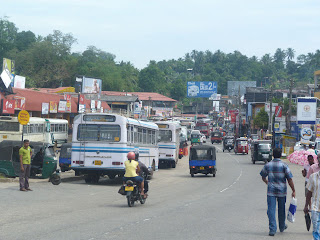
including stopping to try to get some bread and also beer. Here we made a BAD decision and only got 12 cans of Three Coins (at Rs 100 ~ $A0.80 per can). An interesting aspect of the shop was a sign prohibiting photos. Why was this so- we thought the shops interesting but who would object?  This is a smaller shop featuring among its products references to another movie franchise

There were many adverts for TAFE type colleges, quite a few of which mentioned studying to work in Australia.  Frances noted one for the "Academy of Sugar Craft"
Back on the road with a few stops for interesting birds including Honey Buzzard and Crested Serpent Eagle.  Then we got to the place where we swapped vehicles from our van to a Jeep to cart us up a rather basic road to Martin's Simple Lodge. Some commentators on this Lodge had expressed concern about the road,
but I think I would have taken the Subaru up it with little problem and no damage. Whatever, we made it - included a stop to gawp at a Black Eagle out in the valley - and after settling in went out for a birding session with Hettie and our Forest Dept guide Chandra.
This went pretty well and a number of species were recorded. I reckoned that from 3pm we were entitled to regard it as no-carbon birding so this becomes another green day.
 I didn't take any bird images but this orchid was very spiffy:
There were a few "home comforts" out in the forest including well designed shelters
 and a well designed, but leech infested, dunny.
When we got 2km out it started to rain. In fact it poured down and we all got thoroughly wet except Frances who was wearing rain pants. The road effectively transformed from a dusty track to several modest streams within about 10 minutes.
We were also all, except Chandra, wearing Leech Socks which are supposed to keep the little suckers at bay (or at least visible so they could be flicked). This seemed to work for most of us although Rob got well sucked and bled for about 4 hours. (Chandra was not fussed by the leeches: she seemed to feel them creeping around and flicked them off wioth a handy twig.)
Evening meal was enhanced by some of the beer purchased earlier and was quite good although the food was a little blander than we were expecting.
Bird of the Day: Black Eagle
Other Vertebrate of the Day: Ruddy Mongoose
Pattern of the day:  the table top at Martins.
Bad taste of the day:  leeches (The leeches probably rated the leech socks as bad taste of the day!)
Read on

April 20: Baby elephants

After breakfast leave for Centauria Inn, Embilipitiya for one night. Afternoon, visit Udawalawe National Park for dry zone birds and Elephants. Look for dry zone birds, which include Little Green Bee-Eater, Malabar Pied Hornbill & Blue-faced Malkoha. In a visit to Udawalawe National Park close to 50-60 Elephants can be seen and the Nursery Herd, which comprise of many baby Elephants, is one of the key attractions.
 The day began in an early but relaxed manner including watching the Magpies in the eating area. We also got enough of a view of a Giant Squirrel for Hetti to identify it. An impressive black beast with tasteful ginger around the head. Apparently this is a mountain subspecies.  Here is a view of sunrise.

Breakfast was then had, including commercial bread, unanimously rated as inferior to the coconut roti. After trundling down the road to the bottom of the hill Hetti announced we had 40km of bad road and then 50 of good road. In fact the first several kms were quite well surfaced but a tad twisty. It then got rough dirt as surface as we weaved through a few mountains and villages. Much of the area was devoted to tea plantations.  In one, a dog - surprisingly not light brown in colour - had found that a protruding rock was a good spot for guard duty.
If only human security guards were that sensible instead of behaving in the objectionable manner they usually do!
Several of the villages were decked with white banners indicating that funerals were happening. Posters with photos of the deceased were stuck on every flat – or near flat – surface. We found out later that white means an ordinary citizen while yellow bunting means that a monk is being interred. Many of the houses in the villages were painted in gay colours.
As another bit of lifestyle Hetti explained that a sprig of palm flower stuck on the front of a car/van/bus meant the occupants were on a pilgrimage. (Some turned up in Yala a couple of days later: it seems Buddha is into efficiency and agrees that pilgrimages can include game spotting in a National Park where this saves an extra long trip.)
Seven species of bird and some playful monkeys, using the power lines (Rob image)
were spotted in transit before we stoppped for lunch near the Elephant Transit home (where thy are cared for but not allowed to imprint on humans) just outside Udawale NP. Before lunch we inspected a couple of trees known to Hetti and found Collared Scops Owl therein. Not as rare as the Serendib SO but still pretty exciting.
 As I failed to get a shot of the owls - they were rather well concealed - I photographed another snail instead.
Lunch was in a restaurant opposite the transit centre. It was rather bland and one of our number – wearing an Arsenal FC shirt - ordered fish 'n' chips. The menus also featured “Cattle fish”. We were intrigued by the group next to us who seemed to comprise about 6 couples of different nationalities. They also babbled somewhat in a fairly banal way. The conclusion was that they were a Mixed Feeding Flock.
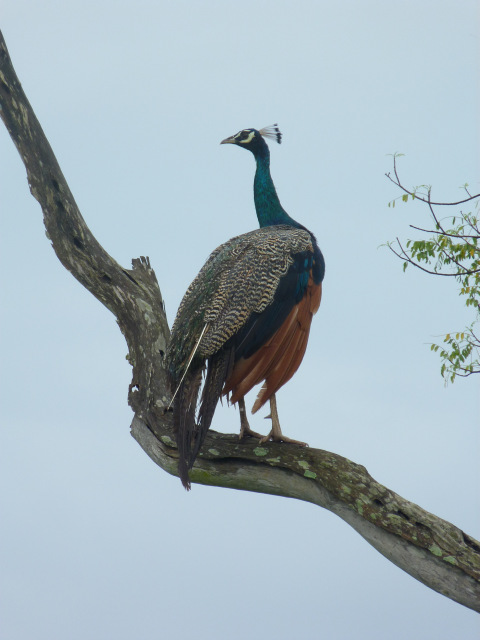
We then rumbled down the road to the Park passing over a big dam. Soon after getting into the park we found our first peacocks.  They were pretty impressive
 When one raised its tail it was very impressive.
 On the other hand, when up in a tree they were very confusing if not seen clearly!

Then we found a large herd of elephant grazing in tall grass so hard to photograph. This is what the Park is known for. After watching them for a while we pressed on, noting that rain was surrounding us on 4 sides. Shortly thereafter rain was above us as well and the top was put on the jeep greatly reducing visibility (which of course the rain had also done). The sides were still open so I was having trouble keeping myself and the camera dry and retreated to join the driver in his cab. As the rain was coming from the passengers side I could see little and hear nothing through the closed, and fogged up, window. I did get to see one big elephant which was within 3m of the drivers open window (the streaking is due to the pouring rain not bad focus)

but didn't even hear folk say that the rain had stopped and the top had been taken off.
When I eventually realised what had happened I returned to the rear where several species were added to the trip list and my life list! We met another elephant wandering along the road but he just prowled on past.
 Malabar Pied Hornbill
 Changeable Hawk Eagle
Our Hotel for the night was about 20 minutes further down the road and was rather grand, The usual business of porters grabbing our bags and then standing around with their hand out was annoying as always. However, sitting on the verandah and having a medicinal dose of Glenlivet overcame our frustration. It also generated the first Geckos of the trip.
Our evening meal was quite pleasant in a bland sort of way. The astonishing bit was when Rob found that some of the little packets of butter had been opened by a previous diner and recycled.
Bird of the day:  Malabar Pied Hornbill
Other vertebrate of the day: elephant eating grass
Pattern of the day: can't remember
Bad taste of the day:  recycled butter (although its taste wasn't actually checked)
Read on
 

April 21 Bundala and Yala

After breakfast leave for Yala Village, Yala for two nights. En route visit Bundala National Park in safari jeeps. Bundala is a fascinating wetland home for 150 species of winter migrant and resident birds. The park is accessed in safari jeeps. The highlight would be large flocks of Greater Flamingos, which could number up to a few hundred. Bundala is a ‘Ramsar’ wetland of Sri Lanka. Among the larger water birds you could also see Lesser Adjutant, Painted Stork, Asian Openbill, Eurasian Spoonbill, Black-headed Ibis and Woolly-necked Stork. Waders that can be seen at Bundala include Pacific Golden, Lesser Sand and Greater Sand, Little Ringed, Kentish and Little Ringed Plovers, Little Stint, Marsh, Common, Wood and Green Sandpipers. You could also see the two odd-looking Eurasian Thick-knee and Great Thick-knee in addition to Eurasian Curlew, Black tailed Godwit, Common Snipe, Red-necked Phalarope, Pintail Snipe and Ruddy Turnstone.


Over this day and the next there were a couple of references to the tsunami of 2004. These have been gathered together in a special page.
As a result of the soggy bit of 20 April and the forecast for the following day Hettie suggested that we slightly change the plan for Bundala and have an early start, visit the Park and then go on to Yala in the afternoon. We agreed quickly and were up and about at 5am.
This meant we left in the dark which made Hettie's headlights and alertness the things which avoided a very large tree which had fallen across the road. He also avoided all the dogs which were gathering in the middle of the road for a convivial sniff round. They seemed to be in larger numbers than usual and also much more alert.
In past blogs I have commented on aspects of technology which have passed some countries by. In the case of Sri Lanka it seems to be the dip switch, particularly on trucks. Tuk-tuks were around early with intersting lighting effects on occasion. Most of them are imported knocked down from India and assembled in Empipitlya while the Piaggio Ape models are imported fully assembled, but from India rather than Italy.
The area around Bundala is the least prosperous in the country and as a result the Government has been doing development projects. These include:
  • an International airport (fair enough as there are nice beaches and Parks to attract punters);
  • an International port (fair enough as there is a lot of passing shipping); and
  • an International Convention Centre (never justified anywhere for any purpose).
There were also a lot of signs around covered with marketing spin and BS about “Empowering Youth” and similar meaningless phrases.
We met our driver and transferred to his jeep for the tour of Bundala NP - a RAMSAR Wetland of International importance site - getting into the Park just after daybreak. This was a brilliant idea as the light was crystal clear and there were lots and lots of birds around, as well as some other animals. Getting the others out of the way first:
  • Grey Langurs – not Langers, Alfie hasn't aged than much;


     Black-necked Hares;
  • Spotted deer; and
  • Mugger Crocodiles.
The latter were in large numbers and some were large in size. A particularly active specimen had gone to sleep in the road, woke as we arrived on an elevated track through the salt fields and dived into the pan alongside.  Here is a shot of it before it climbed on to the road.
Rob got a better image of the beast
 The waterbirds were evident before we got to the Park itself - where no-one seemed to be on duty – but we wandered in and were soon seeing many birds. Grey-headed Fish-eagle was an initial highlight and then several grassland species were seen closely followed by a large colony of terns, with a few waders. Quite a few of the images are in the 'Birds' page but some tasters follow.
Purple Sunbird
 Reflected Pheasant-tailed jacana
 Greater Thick-knee
We dodged around on tracks that were partly submerged - thanks Rob

and came out on to some salt pans. These had a lot of water in them – rotten rain – which had reduced the number and variety of waders and water birds (for example we saw no gulls). After seeing a large crocodile inspecting a pipe between two lagoons (see mage above) we came across small flocks of Red-necked Phalarope ( which I hadn't seen since Ottawa 1991) and Small Pratincole (a lifer). At the end of this we had to return as we didn't have permission to use the private roads in the salt works.
I think we totalled up to 65 species in the park: a really good haul. The clear light certainly helped.
There was then a short drive to Yala, including a stop to look at the Pagoda on a site 2300 years old (the pagoda is more recent) on which the tooth relic was stored during part of its life. The wall around the site was decorated with elephant designs.
We stopped in this village to fill up with diesel and I took the opportunity to snap some of the locals filling up the fuel containers for their tractors etc.  We were quite intrigued as to how they rode the motor bikes wearing sarongs.
It was not uncommon the see someone topping up the fuel in a tuk-tuk from a 1.5l soda bottle.  One of the benefits of no power must be good economy!
We also met up with another bike race, but in more rural surroundings and with a clear leader so not so thrilling as the previous example. It was amusing to see the leader get a bucket of water heaved over him! (The lines in this image ae the heating elements in the rear window of the van.)
The road to the Yala Resort was ungood, taking about 45 minutes to cover about 12 kms. The Resort is excellent being only about 12 years old. Somehow it was not damaged by the tsunami although almost on the beach. I went for a short run around the resort (4 laps at 500m per lap) followed by a swim and a medicinal beer. There were not a huge number of flowers about - I suspect that happens during and after the monsoon - but these yellow blossoms were quite common.
 Note that we were not allowed to go beyond the boundary due to the risk of dangerous animals such as leopards and elephants (and possibly crocodiles which were quite visible in the lagoon next to the pool). A herd of wild boar -about 20 of all sizes – ran past our chalet just before we went to dinner.  The next evening Hettie's brother, also a Jetwing guide, saw a leopard from the Hotel.
 However we were allowed to go onto the beach.  This guy was fishing well out to sea with a very heavy swell running.  I would not have been out there in that boat in those conditions
This shot shows the length of the beach: the fishing boats enter at the far end.
Proving that the waves were quite strong ....
We couldn't resist this shot of a brain-like rock with shadows.
To justify the early start a large thunderstorm started just as dusk fell.
Dinner was buffet style and quite good, once we found the Sri Lankan curry section. A mild annoyance was the wine wallah almost demanding that we had wine rather than the beer which we ordered. We ignored him.
Bird of the Day: Chestnut-headed Bee-eater
Other vertebrate of the Day: Mugger crocodile
Pattern of the day: Elephant design at pagoda
Bad taste of the day: An embarrassment of choice in the attire of our fellow guests.
Read on  

April 23: Nuwara Eliya

After breakfast leave for St.Andrew’s Hotel, Nuwara Eliya for two nights. Afternoon, visit Victoria Garden for Himalayan migrants Kashmir Flycatcher, Pied Thrush Indian Pitta and Indian Blue Robin. Other highlights include Yellow-eared Bulbul, Sri Lanka Hill White-eye and Dull blue Flycatcher.


Today was a relatively relaxed start as we didn't have to leave until about 8;30. As Frances and I strolled across to the breakfast facility we were greatly amused by the antics of a bunch of Grey langurs (ie monkeys) playing around in the bushes and then leaping – with loud thuds – onto the rooves of chalets.
As it was still before opening time we went up to the observation deck to look out over the lagoon. That was a nice view, but what really caught our attention was the sunbirds feedng in the trees below us. Due to the hour and their position they were catching the sun beautifully and really stunning us with their looks. The purple rumps stood out like neon signs – which presumably is the intention!
Once esconced for breakfast we were most amused by a squirrel invading the next table - fortunately unoccupied - and stealing the packets of sugar.
Heading off down the road there was a minor kerfuffle amongst the local dogs and accompanied by a larger kerfuffle in the local Muscovy Duck population. It was later apparent that the cause of this was the need for the assembled stock to remove a fairly large Rat Snake from the area.
There was some excitement when some birds were spotted on the roadside these were Brahminy Starlings (a lifer) and Rose Starlings (added, in a poor sighting, to my life list the previous day after many years of wanting to see one of these birds).  Even on this occasion the image of the Rose Starling was not worth reproducing, but the Brahminy was more obliging.

Our progress was temporarily interrupted by a herd of cattle.  They were a pretty ratty bunch of beasts but did show the 'hot wire brands' rather well.
 The next interesting sight, some kms down the road was a large colony of fruit bats circling their roost tree. (NB: we had seen horseshoe bats flying through the eating area at Martins Simple Lodge.)
As we drove along there was some confusion about distances. It then emerged that the modern, authoritative distance markers were in kilometres, but there were some old Colonial era, markers still showing the distances in miles. Sri Lanka adopted metric measures in 1975 (about the same time as Australia).
Every village seems to have a vendor of clay pots for buffalo curd. They keep them piled up, which caused some small confusion for a while. Buffalo also crossed our path – fortunately, with one exception, not literally by being dead beside the road. A rather more significant road hazard than a dead 'roo. As an aside it is a miracle - due to the concern of the local drivers - that the whole country is not covered with dead dogs: their preferred spot for a sleep is about 60cm out in the road, but thus far we have seen none flattened. (That continued throughout the trip.)
After a couple of hours we turned on to the road up to Nurawa Eliya.  Up was definitely the word as we then climbed steadily for the next two hoirs . We stopped for a look at a large waterfall, linked to the story of a local king stealing a bride from Southern India.  This is not a Bollywood yarn but a very old legend. Most picturesque with specular green-winged dragonflies decorating the rock at the bottom.
 
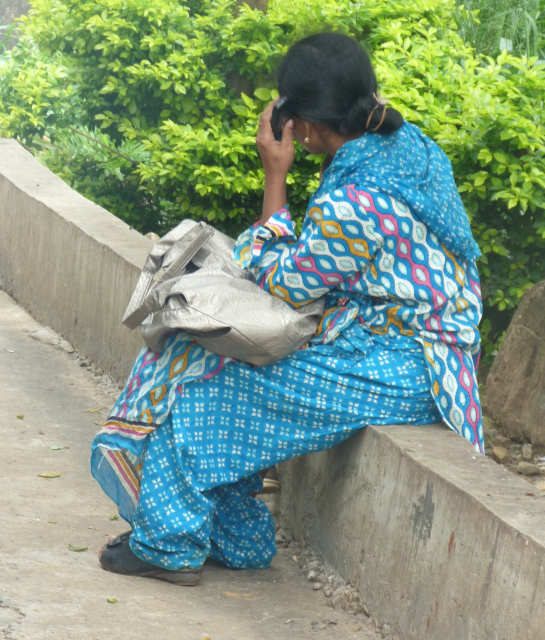
The best snap of a sari was this one of a lady at the falls.

We ascended the road somewhat further and called in at a tea house (elevation 1014m), where we were sponsored, not by the letter T but the letter P.  This image shows the roads weaving up and across the steep hillsides.
On on towards Nuwara Eliya. Sights seen along the road included:
  • Ganesh sitting on a oil drum outside a Hindu Temple; and
  • Buddha sitting in the back of a truck.
There were temples of both Hindu
 and Buddhist persuasions all over the place as well as the occasional Christian edifice.  This roundabout, seem dimly through the customary rain, was an attractive part of a rather crummy town.
In an agricultural sense there were many many acres of terraced hillsides covered with tea plants or, particularly as we neared Nuwara Eliya, vegetable fields. As we had left the low lands some of the rice paddies had been flooded – whether by intent or just as a result of the rain was not clear – and the water was cascading down through openings in the walls.
After reaching NE and checking in to the St Andrews Hotel we headed off to look at some grand buildings (see the Buildings post) Victoria Park to check for Himalayan migrants. They seem to have migrated already as despite an hour or more searching we failed to find any. There were a number of interesting signs observed by Rob, Carol and Frances who decided that looking at the garden was more interesting to them than scouting a polluted creek.
  • Refrain from playing in the park;
  • Refrain from plucking the flowers;
  • Refrain from removing the plants;
  • Behave decently.
Surprisingly there were no jobsworths around to enforce these rules.
There are a couple of images of the gardens taken by Frances.

and one by Rob (which also says something about the weather)
 We went back to another spot near the Grand Hotel where Hettie thought the migrants might be lurking. They weren't but we did spend a little time watching a Velvet Nuthatch, which is a cute little bird.
I then decided to give battle in the Bale Bazaar (sort of collection of factory outlet shacks for Sri Lankan clothing factories) to see if I could get a more waterproof jacket. Many stalls from which the boys were keen to sell me their stuff. All was said to be waterproof and all was Gore-Tex. None of the labels mentioned that trademark but instead said things like 100% nylon on the label. Rob commented that it was very easy to sew in a label, but I reckoned it was even easier to just say something. The final insult was when one of the boys said his offering was 9000Rs (about $A75) and didn't even counter offer to my suggestion that I only had 4000Rs!
Back at the hotel - where this view of the town was taken
 and dinner happened. A waiter tried to serve us two entrees but having eaten one I was keen to move on my “Asian Spacial” featuring vegetable biriyani and grilled paneer. Very tasty it was too.
As a point of interest, at Yala there were several honeymoon couples. At Nuwara Eliya a couple celebrated their 29th wedding anniversary.
Bird of the Day: Brahminy Starling
Other vertebrate of the day: Squirrel stealing sugar;
Pattern of the day: Sari
Bad taste of the day: the spiky hair style at the next table.
Read on