Showing posts with label reptiles. Show all posts

Thursday, March 29, 2012

April 17 Recovery and acclimatisation

Morning, relaxation. Afternoon, visit Talangama Tank to look for birds.


We met our guide (who we call, at his request, Hettie – rather than use his family name Suchithra as advised by Jetwing) after getting the money and joined the chaos in the pick up area while he got the Jetwing van. We then had an hour of touring from 35km N of Colombo through the city and then 15 km east. On route we noticed:
  • Many statues of Buddha, many with flashing blue and red LEDs forming a halo around the head;
  • Lots of turf accountant premises. The first three had police stations opposite which we thought might be a pattern, but then the bookies continued and the copshops disappeared;
  • it was raining and most people carried brollies (even the cops in uniform).
  • There were lots of cattle wandering around and at one point a dozen of them loomed up like the zombies in a Living Dead movie.
Then we got to Villa Talangama. Caesar Augustus would be jealous of a villa as great as this. It is a huge place with just us in it. The staff had stayed up until 2am to greet us, give us a juice and cart our kit around. Excellent. We agreed that breakfast would be at 10 am if we were up by then which we were. This was a huge meal of very healthy stuff served by the excellent staff. It was served under an umbrella beside the pool giving a view over thee Tank. We had a conversation with Hamish - the owner of the Villa - and made arrangements for tea at 7pm (we're going birding with Hettie at 3:30).  Here are a few images of the villa and its fittings (mainly taken by Frances).


 Hamish pointed out that we were lucky to have arrived at 2am as the traditional song festival 50m away had only finished at 1:30am. This was part of the New Years Festivities (which seem to last 5 days at least with New Years Day itself in the middle). Possibly lucky to find we could get rooms etc at this time.
Frances and I arose about 9:30 and were greeted with this view.
We all went for a prowl together (repeating more or less one which Rob and Carol had already done).  A good collection of reptiles were seen:
Land Monitor
 Water Monitor
Garden Lizard
Rob good an excellent image of a Dragonfly, which annoyed me for several minutes by refusing to pose!
Many birds seen, of which several were additions to my life list. My favourites of this stage were initially the White-bellied waterhens

with little fluffball black chicks (which didn't hang around to be photographed), but were overtaken by the Flamebacks- very lurid woodpeckers.  The Tank was a bit low on water, but high on birds as shown in this Rob image.
I then decided to go for a run to the wall of the Tank and perhaps a bit further. When I got about 1km from the Villa there was a lot of interesting stuff happening so I went back and got my camera.
The tractor driver wasn't real happy about having his photo taken even at 50m away. Then I saw the Pheasant-tailed jacanas

and I was a very happy chappy.  A cooling and cleansing dunk in the pool completed the business.
In the afternoon we went for a slightly longer walk with Hettie, where we saw very many birds and generally had an excellent time. Highlights were the whistling ducks and cinnamon bittern. As we had not used the car at all this was all able to be counted as Green Birding.  While relaxing from all this exercise a monkey
ran across the lawn, getting a very steely gaze from Hamish's dog.  (I cannot imagine the battles that would ensue between our small dog an monkeys!)
The evening meal was enlivened with a bottle of Merlot and was generally excellent. The main dish was fish (rated by Hamish as better than chicken - note from later in the trip: this opinion is strongly endorsed) and was accompanied by many tasty vegetables. Definitely a great meal.

Bird of the Day:  Black-rumped Flameback
Other vertebrate of the Day:  Garden lizard
Pattern of the day:  Wrought-iron Gates
Bad taste of the day: none.
Read on


April 19 Sinharaja

Full day birding at Sinharaja Rainforest.  This may be green birding day in Sri Lanka.


I had a fairly ordinary nights sleep, possibly being a little dehydrated and not having a big enough pillow.  Of course at dawn I was solidly asleep and as a result I was not up early enough to see the Sri Lankan Blue Magpies come to feed on moths in the breakfast area. I did get a good look at the rainforest however ....
... and a Junglefowl came to visit.

The place is quite well set up as an eco lodge with solar hot water and his own mini hydro-electric scheme.  It is certainly 'simple' but is also very close to the forest and wildlife (which is the reason for coming here) and all other accommodation is at the foot of the hill about 40 - 60 minutes jeep drive away.  Surprisingly for such a remote place there was good cellphone coverage. Perhaps Telstra should send a mission to Sri Lanka to work out how to do it?  (See below more significant comment on this!)
As no-one had been able to acquire bread yesterday our breakfast included coconut roti: while it looked a bit like dwarf bread (which is inherited not baked) it tasted excellent. It was enhanced by application of Woodapple jam.
The aim of the day was to walk up and down the road to the Research Centre and visit a couple of other places of interest. The first of these was to try to locate the Serendib Scops Owl. We failed, but did find a beautiful green pit viper under a bank.
The other snake species seen on this day was a Keelback.  Nowhere near as attractive or venomous.
As we walked out to the Centre we found some Malabar Trogons. I really like this genus: like parrots but "softer".  Unfortunately they stayed out of camera range. Several of the other endemics were located until we found a gang/family of Sri Lanka Blue Magpies.

It seems that several of the guides feed them at this point, including one bloke who turned up with two German clients. He had the Magpies feeding off the top of his telescope.
This group ended up at the Centre at the same time we did. Then their equivalent of Chandra turned up to say he had found the Sri Lanka Frogmouths. The guide counselled his female client that it would be muddy getting there and that if a leech got her she wasn't to scream as it would scare the froggies. She immediately found a leech on her and screamed which scared the pants off all of us and caused her spectacles to crash to the ground. It was a bit of a struggle getting to the Frogmouth position and very muddy.
Note the white 'spats': they are in fact leech socks which seem to deter the little beasts from going up your leg.  They have other ways in however so constant vigilance is required.
The Frogmouths (an endemic species) were a lot smaller than our home crew and very cute.
At least the Germans were interested in Nature. We saw a Pommie couple who looked very miserable (and totally inappropriately dressed). This was not improved by the large patch of blood on the female's backside where a leech had obviously had a good feed. Two other large groups charged through – one set of Pom blokes wearing shorts and a group of Russian females, some of whom at least were wearing jewel enhanced thongs – in a rain forest!!!
 There were a lot of orchids around.  One species (unidentified) was called 'ground orchid' ...
... while the other, shown in close up yesterday, was Arundina graminifolia was rather tall!
Eat your heart out, Little Dumpies!
Also of interest in the plant department were some Pitcher Plants.  We could distinguish two species, the first of which was quite tall ...
 ... while the second was low, almost on the ground.
We had also enjoyed the masses of butterflies around of which two of the smaller species seemed to take a liking to my shoes. 
Three-spot Grass-yellow
 Angled Pierrot

They were easy to photograph while some of others were impossible. We particularly liked the Tree Nymphs - large, back and white beasts that floated like something out of Avatar! Butterflies will have a separate summary page.
I enjoyed this monster snail
 ...  and this attractive spider species popped up at various points throughout the trip.
A few other arthropods were also of interest, especially the millipedes. These were a contender for pattern of the day.  Rob took the snap, and marvelled that anyone - in this case Frances obliged - would put their hand in that close for scale.
 I also liked the shapes made by the vicious thorns on this rattan palm.
We had walked halfway back to the Lodge when a flock came through so beetled off to look at it. A Red-faced Malkoha was found as part of theflock: very pleasing as our trip was based on a Jetwing standard “Malkohas and Leopards” outing. We then went back to the Research Centre. While there we noticed the cloud building up again and sure enough got wet again. Taking off my leech socks and checking my clothes and body I found I had carted 10 leeches back to the Lodge. Yecccch!
Bird of the Day:  Malabar Trogon (the Magpies were semi tame)
Other Vertebrate of the Day:  Green Pit viper
Pattern of the Day:  Can't remember!!
Bad taste of the Day:  Bejewelled thongs on Russian tourists.

Read on

April 20: Baby elephants

After breakfast leave for Centauria Inn, Embilipitiya for one night. Afternoon, visit Udawalawe National Park for dry zone birds and Elephants. Look for dry zone birds, which include Little Green Bee-Eater, Malabar Pied Hornbill & Blue-faced Malkoha. In a visit to Udawalawe National Park close to 50-60 Elephants can be seen and the Nursery Herd, which comprise of many baby Elephants, is one of the key attractions.
 The day began in an early but relaxed manner including watching the Magpies in the eating area. We also got enough of a view of a Giant Squirrel for Hetti to identify it. An impressive black beast with tasteful ginger around the head. Apparently this is a mountain subspecies.  Here is a view of sunrise.

Breakfast was then had, including commercial bread, unanimously rated as inferior to the coconut roti. After trundling down the road to the bottom of the hill Hetti announced we had 40km of bad road and then 50 of good road. In fact the first several kms were quite well surfaced but a tad twisty. It then got rough dirt as surface as we weaved through a few mountains and villages. Much of the area was devoted to tea plantations.  In one, a dog - surprisingly not light brown in colour - had found that a protruding rock was a good spot for guard duty.
If only human security guards were that sensible instead of behaving in the objectionable manner they usually do!
Several of the villages were decked with white banners indicating that funerals were happening. Posters with photos of the deceased were stuck on every flat – or near flat – surface. We found out later that white means an ordinary citizen while yellow bunting means that a monk is being interred. Many of the houses in the villages were painted in gay colours.
As another bit of lifestyle Hetti explained that a sprig of palm flower stuck on the front of a car/van/bus meant the occupants were on a pilgrimage. (Some turned up in Yala a couple of days later: it seems Buddha is into efficiency and agrees that pilgrimages can include game spotting in a National Park where this saves an extra long trip.)
Seven species of bird and some playful monkeys, using the power lines (Rob image)
were spotted in transit before we stoppped for lunch near the Elephant Transit home (where thy are cared for but not allowed to imprint on humans) just outside Udawale NP. Before lunch we inspected a couple of trees known to Hetti and found Collared Scops Owl therein. Not as rare as the Serendib SO but still pretty exciting.
 As I failed to get a shot of the owls - they were rather well concealed - I photographed another snail instead.
Lunch was in a restaurant opposite the transit centre. It was rather bland and one of our number – wearing an Arsenal FC shirt - ordered fish 'n' chips. The menus also featured “Cattle fish”. We were intrigued by the group next to us who seemed to comprise about 6 couples of different nationalities. They also babbled somewhat in a fairly banal way. The conclusion was that they were a Mixed Feeding Flock.
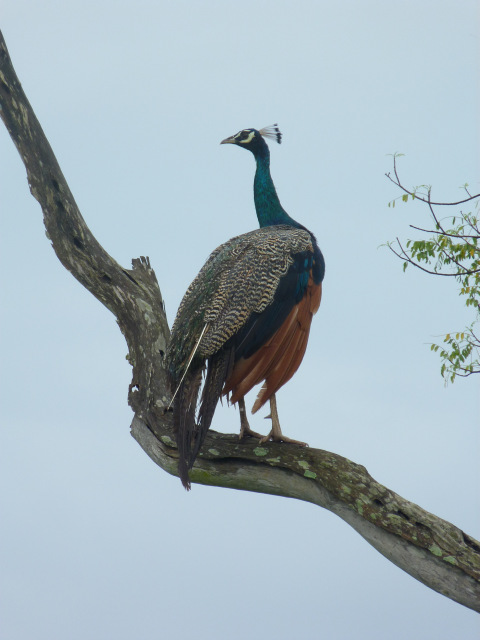
We then rumbled down the road to the Park passing over a big dam. Soon after getting into the park we found our first peacocks.  They were pretty impressive
 When one raised its tail it was very impressive.
 On the other hand, when up in a tree they were very confusing if not seen clearly!

Then we found a large herd of elephant grazing in tall grass so hard to photograph. This is what the Park is known for. After watching them for a while we pressed on, noting that rain was surrounding us on 4 sides. Shortly thereafter rain was above us as well and the top was put on the jeep greatly reducing visibility (which of course the rain had also done). The sides were still open so I was having trouble keeping myself and the camera dry and retreated to join the driver in his cab. As the rain was coming from the passengers side I could see little and hear nothing through the closed, and fogged up, window. I did get to see one big elephant which was within 3m of the drivers open window (the streaking is due to the pouring rain not bad focus)

but didn't even hear folk say that the rain had stopped and the top had been taken off.
When I eventually realised what had happened I returned to the rear where several species were added to the trip list and my life list! We met another elephant wandering along the road but he just prowled on past.
 Malabar Pied Hornbill
 Changeable Hawk Eagle
Our Hotel for the night was about 20 minutes further down the road and was rather grand, The usual business of porters grabbing our bags and then standing around with their hand out was annoying as always. However, sitting on the verandah and having a medicinal dose of Glenlivet overcame our frustration. It also generated the first Geckos of the trip.
Our evening meal was quite pleasant in a bland sort of way. The astonishing bit was when Rob found that some of the little packets of butter had been opened by a previous diner and recycled.
Bird of the day:  Malabar Pied Hornbill
Other vertebrate of the day: elephant eating grass
Pattern of the day: can't remember
Bad taste of the day:  recycled butter (although its taste wasn't actually checked)
Read on
 

April 21 Bundala and Yala

After breakfast leave for Yala Village, Yala for two nights. En route visit Bundala National Park in safari jeeps. Bundala is a fascinating wetland home for 150 species of winter migrant and resident birds. The park is accessed in safari jeeps. The highlight would be large flocks of Greater Flamingos, which could number up to a few hundred. Bundala is a ‘Ramsar’ wetland of Sri Lanka. Among the larger water birds you could also see Lesser Adjutant, Painted Stork, Asian Openbill, Eurasian Spoonbill, Black-headed Ibis and Woolly-necked Stork. Waders that can be seen at Bundala include Pacific Golden, Lesser Sand and Greater Sand, Little Ringed, Kentish and Little Ringed Plovers, Little Stint, Marsh, Common, Wood and Green Sandpipers. You could also see the two odd-looking Eurasian Thick-knee and Great Thick-knee in addition to Eurasian Curlew, Black tailed Godwit, Common Snipe, Red-necked Phalarope, Pintail Snipe and Ruddy Turnstone.


Over this day and the next there were a couple of references to the tsunami of 2004. These have been gathered together in a special page.
As a result of the soggy bit of 20 April and the forecast for the following day Hettie suggested that we slightly change the plan for Bundala and have an early start, visit the Park and then go on to Yala in the afternoon. We agreed quickly and were up and about at 5am.
This meant we left in the dark which made Hettie's headlights and alertness the things which avoided a very large tree which had fallen across the road. He also avoided all the dogs which were gathering in the middle of the road for a convivial sniff round. They seemed to be in larger numbers than usual and also much more alert.
In past blogs I have commented on aspects of technology which have passed some countries by. In the case of Sri Lanka it seems to be the dip switch, particularly on trucks. Tuk-tuks were around early with intersting lighting effects on occasion. Most of them are imported knocked down from India and assembled in Empipitlya while the Piaggio Ape models are imported fully assembled, but from India rather than Italy.
The area around Bundala is the least prosperous in the country and as a result the Government has been doing development projects. These include:
  • an International airport (fair enough as there are nice beaches and Parks to attract punters);
  • an International port (fair enough as there is a lot of passing shipping); and
  • an International Convention Centre (never justified anywhere for any purpose).
There were also a lot of signs around covered with marketing spin and BS about “Empowering Youth” and similar meaningless phrases.
We met our driver and transferred to his jeep for the tour of Bundala NP - a RAMSAR Wetland of International importance site - getting into the Park just after daybreak. This was a brilliant idea as the light was crystal clear and there were lots and lots of birds around, as well as some other animals. Getting the others out of the way first:
  • Grey Langurs – not Langers, Alfie hasn't aged than much;


     Black-necked Hares;
  • Spotted deer; and
  • Mugger Crocodiles.
The latter were in large numbers and some were large in size. A particularly active specimen had gone to sleep in the road, woke as we arrived on an elevated track through the salt fields and dived into the pan alongside.  Here is a shot of it before it climbed on to the road.
Rob got a better image of the beast
 The waterbirds were evident before we got to the Park itself - where no-one seemed to be on duty – but we wandered in and were soon seeing many birds. Grey-headed Fish-eagle was an initial highlight and then several grassland species were seen closely followed by a large colony of terns, with a few waders. Quite a few of the images are in the 'Birds' page but some tasters follow.
Purple Sunbird
 Reflected Pheasant-tailed jacana
 Greater Thick-knee
We dodged around on tracks that were partly submerged - thanks Rob

and came out on to some salt pans. These had a lot of water in them – rotten rain – which had reduced the number and variety of waders and water birds (for example we saw no gulls). After seeing a large crocodile inspecting a pipe between two lagoons (see mage above) we came across small flocks of Red-necked Phalarope ( which I hadn't seen since Ottawa 1991) and Small Pratincole (a lifer). At the end of this we had to return as we didn't have permission to use the private roads in the salt works.
I think we totalled up to 65 species in the park: a really good haul. The clear light certainly helped.
There was then a short drive to Yala, including a stop to look at the Pagoda on a site 2300 years old (the pagoda is more recent) on which the tooth relic was stored during part of its life. The wall around the site was decorated with elephant designs.
We stopped in this village to fill up with diesel and I took the opportunity to snap some of the locals filling up the fuel containers for their tractors etc.  We were quite intrigued as to how they rode the motor bikes wearing sarongs.
It was not uncommon the see someone topping up the fuel in a tuk-tuk from a 1.5l soda bottle.  One of the benefits of no power must be good economy!
We also met up with another bike race, but in more rural surroundings and with a clear leader so not so thrilling as the previous example. It was amusing to see the leader get a bucket of water heaved over him! (The lines in this image ae the heating elements in the rear window of the van.)
The road to the Yala Resort was ungood, taking about 45 minutes to cover about 12 kms. The Resort is excellent being only about 12 years old. Somehow it was not damaged by the tsunami although almost on the beach. I went for a short run around the resort (4 laps at 500m per lap) followed by a swim and a medicinal beer. There were not a huge number of flowers about - I suspect that happens during and after the monsoon - but these yellow blossoms were quite common.
 Note that we were not allowed to go beyond the boundary due to the risk of dangerous animals such as leopards and elephants (and possibly crocodiles which were quite visible in the lagoon next to the pool). A herd of wild boar -about 20 of all sizes – ran past our chalet just before we went to dinner.  The next evening Hettie's brother, also a Jetwing guide, saw a leopard from the Hotel.
 However we were allowed to go onto the beach.  This guy was fishing well out to sea with a very heavy swell running.  I would not have been out there in that boat in those conditions
This shot shows the length of the beach: the fishing boats enter at the far end.
Proving that the waves were quite strong ....
We couldn't resist this shot of a brain-like rock with shadows.
To justify the early start a large thunderstorm started just as dusk fell.
Dinner was buffet style and quite good, once we found the Sri Lankan curry section. A mild annoyance was the wine wallah almost demanding that we had wine rather than the beer which we ordered. We ignored him.
Bird of the Day: Chestnut-headed Bee-eater
Other vertebrate of the Day: Mugger crocodile
Pattern of the day: Elephant design at pagoda
Bad taste of the day: An embarrassment of choice in the attire of our fellow guests.
Read on