Morning, visit Peradeniya
Botanical Gardens, the largest and finest garden in Sri Lanka,
covering almost 150 acres and stuffed with a bewildering variety of local and
foreign tree and plant species. The area around the entrance is largely given
over to small- scale flora, including an orchid house, a spice garden and a
tiny rather unimpressive Japanese
Garden. Afternoon, visit Temple of the
Sacred Tooth Relic, Kandy,
which is an object of veneration to Buddhists and the most important sacred
relic in the country. Also do a city tour.
While I have tried to reduce the volume of this post by putting many images in special posts it is still pretty big. Sorry (well not really, it is a lovely town).
After the drama of the previous day this one dawned most
peacefully. I think I had the best
nights sleep of the trip so far. Rob had
a good enough kip that he went for a run, spotting our driver washing the van en
route. We went for breakfast in a rather plush area:

Some other photographs of the dining arrangements at the Citadel are on the food page.
Our replacement guide, Nandana – referred to, at his invitation, as Nanda – fronted at 9am to take us around the Kandy Botanic Gardens. Before we got there we passed some wedding houses where the rich of Kandy were marrying off their kids. This was pretty spectactular! Most of the images are in a special page, but here is a taster
 I have little idea why all this stuff was
going on at 9:30am on a Saturday - but it did mean mean we could pass on the evening cultural extravaganza, having seen the real deal.
I have little idea why all this stuff was
going on at 9:30am on a Saturday - but it did mean mean we could pass on the evening cultural extravaganza, having seen the real deal.
Our replacement guide, Nandana – referred to, at his invitation, as Nanda – fronted at 9am to take us around the Kandy Botanic Gardens. Before we got there we passed some wedding houses where the rich of Kandy were marrying off their kids. This was pretty spectactular! Most of the images are in a special page, but here is a taster

The gardens are rather large – about 150 Ha – and seemed to be set
up for a number of purposes . Most of
the specimens are well labelled (a major lesson for ANBG) and the colour of the
label indicated key attributes (green being for medically important plants. Unfortunately when Nanda explained this I was
distracted by the behaviour of a bunch of Middle Eastern Yoicks who were
behaving like stereotyped yoicks who have escaped from the doctrinaire
minders i.e. disgracefully (see below).
I questioned the labelling of a Queensland Kauri Pine,
thinking it was a misprint of NZ Kauri.
Uncle Google assures me the Sri Lankans had got it right. Various birds were heard and a few seen. We also found a large colony of Flying Foxes which were the likely source of the flock seen flying up the river past the hotel.
 I will confess to being very slack and not recording the full details of everything we saw. I do know that the first two images are of the Cannonball tree - so named because the fruit from these flowers resemble those weapons.
 This is the whole tree:
 and here is a sign commemorating the planting of one.
 Some other flowers were recorded:


 as was a turtle (in life, its neck had pretty orange spots - these may be visible in an enlarged image)


The others went to a jewellery workshop while I stayed outside to photograph the chaos on the street.
 We then returned to the Hotel for a bit of R&R before
heading out again for a City Tour to check the Tooth Shrine and various
commercial establishments. And the Kandy
Cricket Ground.
We then returned to the Hotel for a bit of R&R before
heading out again for a City Tour to check the Tooth Shrine and various
commercial establishments. And the Kandy
Cricket Ground.

The tooth shrine was quite excellent with many interesting
statues and carvings. Most of the images are in a special page. It is also an
active place of worship: at one point we got slightly muddled with the
queue to go and view the casket in which the tooth is stored. At the entrance Nanda pointed out how and where terrorists had reacted to that by using a lorry bomb in 1998. While there were a few other tourists around the majority of the folk in the Temple seemed to be ordinary Sri Lankans doing their religious observances, or children being educated

which I see as making the place far more interesting than just an historic ruin.
Here are a few images to give an idea of the place.

 This third image shows the votive offerings left by people seeking the assistance of the Buddha (eg in recovering from illness) .
 There were animals around the place. Some cute
 while others such as the inhabitants of this wasps nest are neither cute nor welcome.

which I see as making the place far more interesting than just an historic ruin.
Here are a few images to give an idea of the place.


After spending the time there we headed off for the city tour. I got things off on a reasonable footing by acquiring an extra pendrive since I had filled the 2Gb one I was using to back up my photographs. I lost a few points with Nanda by paying too much for it (1500R rather than 1000R) but it was generally agreed that the shopkeeper could see that he was going to sell me one anyway so I was in a poor haggling position!
The next stop was a Batik factory and retail emporium. A very nice young lady explained how batik is made and then conducted us to the showroom where we could buy some of the produce. Frances obliged in a moderately large way (getting a special discount - ie the one given to everyone who doesn't actually beat up the employees of the place).
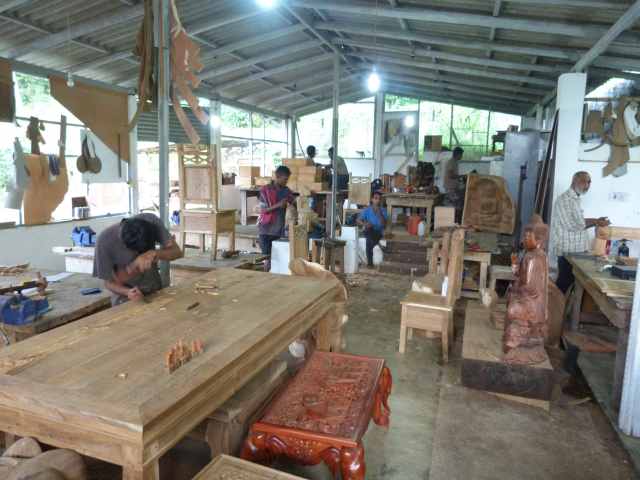
 Next door to this was a wood products factory in which we were shown the various types of wood used (most of which we had seen growing in the morning) were able to seen the craftsmen creating stuff and were then given a demonstration of the properties of rainbow wood. Some wood was given a good rasping and the shavings treated with various liquids which changed colour dramatically. Proving that everything is on the internet You-tube has a video of a similar demonstration plus text of the various things added.

 After acquiring some additional drinking water we visited another important site for Sri Lankans: the Kandy Cricket Ground at which test matches are played. It is the home of the Old Trinitonians (I think - it might have been the Old Trininians although the Upper Sixth were unfortunately not seen). The ground was rather small - I think the capacity was 5,000 and for a Test the tickets cost $50 a head. This was a strange visit as the entrance we used was a building site and I am sure we would not have wandered in without a local guide and Nanda would probably have been told to go away if he didn't have foreigners with him! The action on the ground was training for the local hockey teams.
 Street cricket was also happening. Robs photo (1st) and mine (2nd) capture the poetry in motion of the game.


According to the posters around town Rugby was also popular!



According to the posters around town Rugby was also popular!
In the evening I decided that a bottle of refreshing beverage from the minibar would be in order. Using the hotel wall mounted opener I managed to wrench the top off the bottle. A call to the receptionist resulted in a man coming to inspect situation and another beng despatched with a replacement bottle. The man with the replacement looked very dubiously at the opener and used it very carefully to avoida repeat. All done very pleasantly and efficiently.
That evening as we were finishing our meal Nanda turned up at the table saying he had found a Collared Scops Owl in a tree outside the Hotel. It would have been discourteous of me to not go to look, plus they are cute little birds! He does everything he can to show us stuff.
Bird of the day: Indian Shag
Other vertebrate of the day: Flying Fox
Pattern of the day: Tooth Temple generally
Bad taste of the day: The behaviour of some middle-Eastern-ancestry yoicks at the entrance to the Botanic Gardens.
There were a couple of strong contenders who walked the red carpet in category 4. These were:
There were a couple of strong contenders who walked the red carpet in category 4. These were:
- a pair of tennis shoes with 6" high soles seen at the Gardens and
- the question - fortunately not heard by Nanda - "How long does a tooth last?"


