Showing posts with label elephant. Show all posts

Thursday, March 29, 2012

April 20: Baby elephants

After breakfast leave for Centauria Inn, Embilipitiya for one night. Afternoon, visit Udawalawe National Park for dry zone birds and Elephants. Look for dry zone birds, which include Little Green Bee-Eater, Malabar Pied Hornbill & Blue-faced Malkoha. In a visit to Udawalawe National Park close to 50-60 Elephants can be seen and the Nursery Herd, which comprise of many baby Elephants, is one of the key attractions.
 The day began in an early but relaxed manner including watching the Magpies in the eating area. We also got enough of a view of a Giant Squirrel for Hetti to identify it. An impressive black beast with tasteful ginger around the head. Apparently this is a mountain subspecies.  Here is a view of sunrise.

Breakfast was then had, including commercial bread, unanimously rated as inferior to the coconut roti. After trundling down the road to the bottom of the hill Hetti announced we had 40km of bad road and then 50 of good road. In fact the first several kms were quite well surfaced but a tad twisty. It then got rough dirt as surface as we weaved through a few mountains and villages. Much of the area was devoted to tea plantations.  In one, a dog - surprisingly not light brown in colour - had found that a protruding rock was a good spot for guard duty.
If only human security guards were that sensible instead of behaving in the objectionable manner they usually do!
Several of the villages were decked with white banners indicating that funerals were happening. Posters with photos of the deceased were stuck on every flat – or near flat – surface. We found out later that white means an ordinary citizen while yellow bunting means that a monk is being interred. Many of the houses in the villages were painted in gay colours.
As another bit of lifestyle Hetti explained that a sprig of palm flower stuck on the front of a car/van/bus meant the occupants were on a pilgrimage. (Some turned up in Yala a couple of days later: it seems Buddha is into efficiency and agrees that pilgrimages can include game spotting in a National Park where this saves an extra long trip.)
Seven species of bird and some playful monkeys, using the power lines (Rob image)
were spotted in transit before we stoppped for lunch near the Elephant Transit home (where thy are cared for but not allowed to imprint on humans) just outside Udawale NP. Before lunch we inspected a couple of trees known to Hetti and found Collared Scops Owl therein. Not as rare as the Serendib SO but still pretty exciting.
 As I failed to get a shot of the owls - they were rather well concealed - I photographed another snail instead.
Lunch was in a restaurant opposite the transit centre. It was rather bland and one of our number – wearing an Arsenal FC shirt - ordered fish 'n' chips. The menus also featured “Cattle fish”. We were intrigued by the group next to us who seemed to comprise about 6 couples of different nationalities. They also babbled somewhat in a fairly banal way. The conclusion was that they were a Mixed Feeding Flock.
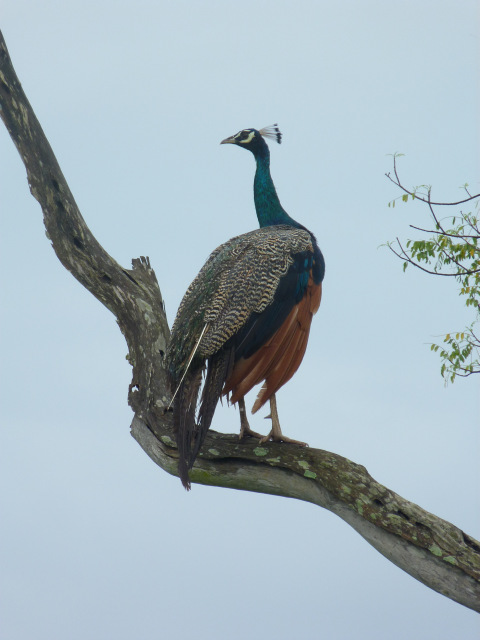
We then rumbled down the road to the Park passing over a big dam. Soon after getting into the park we found our first peacocks.  They were pretty impressive
 When one raised its tail it was very impressive.
 On the other hand, when up in a tree they were very confusing if not seen clearly!

Then we found a large herd of elephant grazing in tall grass so hard to photograph. This is what the Park is known for. After watching them for a while we pressed on, noting that rain was surrounding us on 4 sides. Shortly thereafter rain was above us as well and the top was put on the jeep greatly reducing visibility (which of course the rain had also done). The sides were still open so I was having trouble keeping myself and the camera dry and retreated to join the driver in his cab. As the rain was coming from the passengers side I could see little and hear nothing through the closed, and fogged up, window. I did get to see one big elephant which was within 3m of the drivers open window (the streaking is due to the pouring rain not bad focus)

but didn't even hear folk say that the rain had stopped and the top had been taken off.
When I eventually realised what had happened I returned to the rear where several species were added to the trip list and my life list! We met another elephant wandering along the road but he just prowled on past.
 Malabar Pied Hornbill
 Changeable Hawk Eagle
Our Hotel for the night was about 20 minutes further down the road and was rather grand, The usual business of porters grabbing our bags and then standing around with their hand out was annoying as always. However, sitting on the verandah and having a medicinal dose of Glenlivet overcame our frustration. It also generated the first Geckos of the trip.
Our evening meal was quite pleasant in a bland sort of way. The astonishing bit was when Rob found that some of the little packets of butter had been opened by a previous diner and recycled.
Bird of the day:  Malabar Pied Hornbill
Other vertebrate of the day: elephant eating grass
Pattern of the day: can't remember
Bad taste of the day:  recycled butter (although its taste wasn't actually checked)
Read on
 

April 22: Leopards yes, some other cat-names no.

Morning and afternoon safaris at Yala National Park. The park is also good for dry zone specialties like Indian and Great Thick-knees, Sirkeer and Blue-faced Malkohas and Malabar Pied Hornbill. The park is probably the best place to see the rare Black-necked Stork. A day's birding in the park, during the northern winter, can yield a 100 species. The biggest draws in Yala are Elephants, Leopards and Sloth Bears. A recent study has shown that Yala has one of the highest densities of Leopards in the world.


This day involved another early start as it was important to get into the Park early. Unlike other places we had been there are many jeeps in the park with many coming from Yala Village on the main road. This reflects groming recognition of the high density of leopards in the Park. As Rob and Carol commented, in Africa leopard is the hardest of the Big 5 to nail (in all the visits we have made to Parks in Tanzania and South Africa, the best we did was a bit of spotted rope hanging from a tree).
Our first departure from the resort was marred by a major vicious stoush amongst the dogs that hang around. As Sri Lankan dogs are usually very mellow like this lot at the main entrance to the park

this must be engendered by the behaviour of the tourists.
The first task of the day was to arrive at a collective noun for the jeeps. As they all sped off in a cloud of dust I liked the term “Jeremiad” but now agree that Frances offering of a “Jig of Jeeps” is more appropriate as it gets across the bouncy motion on the rough roads.
One point to note is that all the jeeps in Yala (as with Bundala but not Udawawele) have to have covered backs. This is to stop the leopards jumping in from trees.
We turned off onto a side road to escape the chaos and to see if we could find a leopard on some rocks.  A Ruddy Mongoose was found very quickly.
Suddenly we heard a loud cough, which was identified as a leopard mating call, and the spotty chap was picked up on top of a rock.
 Here it is zoomed a bit!
 He headed off, and us and the other two jeeps in the area headed back to where it was thought likely he would cross the road. Sure enough he did, but unfortunately was spooked by a private (ie not professional) jeep driver and headed into the scrub.
We meandered about a bit, writing down quite a few birds and me failing many times to get a decent photograph of a Little Green Bee-eater.   Frances did a better job with this species.

I did get a few other snaps:
Spotted Deer
 Lesser Adjudant and friends
 We came across a family of elephants notable for:
  • the bull being in must; and
  • one of the females (closest in this image) being heavily in calf. It was thought at one point that the baby could be seen to kick.
A new species of bird - Egretta pachydermis the Elephant Egret - was also present.
 Eventually we stopped for breakfast at the tsunami memorial, along with many other jeeps. The behaviour of many of the tourists was a little ordinary since they seemed to feel it necessary to drape themselves over their guides and drivers for photographs. One couple added to this with clothing that was an assault on most senses.
 No more major excitements during the morning session but I feel these images are worth sharing with you.
 Rocks at the end of the beach
 A huge beetle dining on purple flowers
 A Grey Mongoose (note lack of black in the tail)
 A mass of pretty water lilies
 They also nice when a single flower is reflected!
We returned to the resort for lunch. We noted a buffalo calf – with its mother getting very closely checked over by a croc. The mother was missing a front hoof, suggesting she had already had a battle with a croc.
After lunch – livened up by a family of wild boar coming through past our chalet

– we went to the beach to see if it had changed since the previous day. It hadn't.  Returning to our chalet the dog which had adopted us was in residence.
We then returned to the Park for a second go at leopards. Hetti had received information about a mother and three cubs being seen near the breafkfast spot. So the idea as to head off tothat area.
One of the small lakes we passed was well endowed with waterbirds which occupied us for a while before we got to a “rough road”. A t another lake (really a pond) we got close looks at a Painted Stork, seeing the pink 'flush' on the wings for the first time.
Also well decorated was this butterfly, which from its resemblance to Australian species I decided was a Jezabel.
The rough road was a bit bumpy for a while but didn't seem too tough until we got to a drop off a rock ledge which was very dodgy. It appeared at one point we had got jammed or the car was at such a precarious angle it couldn't move forwards or backwards (sideways rotation was an option). However we got out of it, with possible modifications to the tailpipe.
After getting back to the main road monkeys were giving an alarm call so some minutes were invested in trying to spot the leopard which had disturbed them. We failed and as it was getting towards Park closing time headed for the gate. After a few km we came across a Jam of Jeeps. This is the stationary version of a Jig.
 A leopard was sitting up in a tree about 100m from the road.
(This is the traditional African view of a leopard.)
 Eventually most of the jeeps nicked off and we got some reasonable views. Frances was watching when it stood up and descended. Hetti established that it was coming towards the road and after a couple of minutes it emerged and walked up the road with 3 jeeps following it. It was a young female so definitely a different animal to the full adult male we seen in the morning. (I apologise for invading her privacy.)

Eventually she moved into the bushes and we moved on, but not far, as another leopard was seen in the bushes. It didn't emerge but we did get fleeting looks. Off to the gate - only a few minutes after official closing time. A very satisfactory expedition.
Evening meal was a similar deal to the previous one, even to the extent of getting the same table. The highlight for me was the Cuttlefish black curry which had certainly not been toned down for European tastes.
Bird of the Day: Painted Stork
Other vertebrate of the day: Leopard (hardly a surprise I suggest)
Pattern of the day: Peacock
Bad taste of the day: Daggy couple at the breakfast spot
Read on.

Monday, March 19, 2012

April 30 Cultural sites

Day excursion to Anuradhapura, the first capital of Sri Lanka founded in the 4th century BC. See the sacred Bo Tree, the oldest historically documented tree in the world, Abayagiri monastery, which housed 5,000 monks and Jetavana Stupa, the tallest stupa in the world. Afternoon, visit Dambulla Cave Temple with murals, statues etc.

The day began with a joint run from the Hotel across the wall of the dam creating the big lake - really a tank.  This was very pleasant with the sun rising in the general direction of Sigirya and lighting up the bigger mountains across the lake.
 Being overtaken by a tuk-tuk is not a common event while running in Canberra!
As we headed off to breakfast the laundry cart passed by attracting some excitement from other guests.
At least one of them was obviously alert to me photographing them, as well as the laundry cart.  After breakfasting (where much entertainment was provided by a staff member dissuading a squirrel from raiding the sugar supply - this must be a common event as we also saw this at Yala) we embarked on the trek to Anuradhapura, which seems to be considered the major archaeological site in the cultural triangle.  Early in the drive we went past a mosque - they have been few and far between on this trip.

The drive was moderately chaotic as the road North (A9) from Dambulla was subject to road works for about the first 30km which meant it was very slow going.  Of course there were 'men with flags' trying to stop the traffic in various places  but they only had moderate success: motorbikes in particular just seemed to swerve round them.  The ways in which things get transported possibly doesn't help:

The second image is someone's roof moving from a coconut grove to their dwelling!  Given the amount of traffic and the narrowness of the roads it was astonishing that there were so few prangs: we had only seen one crash so far in the trip.  This could be attributed to the slow speeds used even when the road is clear.  (Before anyone gets excited about introducing even slower speed limits to Australia I'd point out that travelling at Sri Lankan speeds it would take about 4 days to get from Canberra to Adelaide!)

Part of the issue with the road works was the number of bridges over small canals and drains.  Rob estimated that we must have gone over 50 or more of them and in each case they were fixing up half the road so it became effectively one lane wide.  As we were basically going through a flood plain of paddyfields for most of this time, with the road on an embankment, it wasn't possible to simply stick in a diversion.  Frances noted that one Ministry was that of Water and Drainage, indicating that the issue was more getting rid of the water than finding it!

As the day's schedule was pretty full we didn't stop much.  Once for a Brahminy Kite posing in a tree close to road and again for a sneak preview of the main stupas (stupae?) from across a lake near Anuradhapura.

It must be confessed that by this stage of the trip we were suffering a little from Temple Fatigue (and also Long Name Fatigue).   Thus I will not, at this stage at least attempt to name all the edifices we visited, and I suspect in this area we only did a small proportion of those available.  At each place we had to take our shoes and socks off and our hats.  Not only did this show respect to the Buddha but enabled - in most cases - an entrepreneur to earn 25R each for minding them.  The site post has more images.

The first place we visited  involved a climb up a small number (relative to Sigirya) of steps to a viewing area next to a small stupa.  On the way down Nanda pointed out a slot cave well supplied with roosting bats.


The next major site we visited was noted as being that of the oldest tree in the world at 2,300 years.  It is a Bo tree (Ficus religiosa) and is a cutting from the tree in India under which the Buddha sat to achieve enlightenment.  From a list of oldest trees it appears that this needs a bit of qualification, in that it is the oldest tree for which the age is based on documentation rather than ring-counting.  This site was attended by quite high security as it had been targeted for terrorist activity in the past.
The associated temple had just finished a morning ceremony which meant that it was fairly packed with pilgrims muttering their prayers, giving the place a very different feel to  other temples we visited.  The religious folk didn't appear to object to tourists wandering through, and we did of course try to do this a respectful way.  Possibly Buddha smiled on me for my good karma,  as on emerging my camera dropped from my bumbag and bounced down the road.  While a few scratches were added it was undamaged in terms of function.

The next major site was the tallest stupa in Sri Lanka.
 We were a little delayed in getting there as we thought we heard Nanda's phone go off, but he got excited as it was not his ring-tone but the bird on which it was based, an Indian Cuckoo.  We had to pursue the bird for some distance but eventually got very good looks at it.

On entering the compound around the stupa - without our shoes or socks - we discovered it was rather hot underfoot, especially on the red tiles.  Frances decided to remain with her feet on some shaded tiles, rather than getting third degree burns.  The rest of us made it round, noting the odd bucket of whitewash sailing overhead on a sort of flying fox wire as the guys up top repainted the stupa.  The wire is visible in the centre-top of this image from Rob, which also shows the bamboo ladder the guys climbed up (I would take second prize).

Nanda pointed out that if one put one's toes against the base of the stupa the pinnacle was not visible, but moving out 0.3m allowed it to reappear.  This effect is consistent around the entire edifice demonstrating the considerable mathematical - and construction - skills of the builders.

After a few more ruins we headed off towards Minneriya National Park.  En route we saw our second prang of the trip where a coach had speared into a ditch and the LH front had crumpled into a tree.  If the front passenger had not been wearing a seat belt I suspect they were not at all well.  We stopped a little later for some curries, arriving at the park about 3pm.

We then transferred to a jeep acquiring as usual a driver (from the jeep company) and a tracker from the NP team.  (The use of trackers is a way the NP 'compensate' the local community for curtailing their exploitation of the area.)  In this case the two new folk did not work well together: when the tracker tapped the rail (with a stone, rather than the traditional 5R coin) the driver often didn't stop immediately or went forwards when the tracker wanted him to reverse.  We decided this was a bit like Laurel and Hardy (without the humour).

There were very few birds around also so the driver started adding stops for species such as peacock - of which we had had a surfeit.  Earning a few more bangs with a rock on the frame of the jeep.  Things improved somewhat when we got to a large lake.  In the dry season this is the only water around and attracts large numbers of elephants  but they were all thought to be far away as there was plenty of water in the Park.  We went and parked on the lake shore and the tracker then spotted a Golden Jackal which was shortly joined by two others.
Good call!  The driver earned himself a trip down the red carpet later in the evening by standing on the bonnet, making a noise.

Movie references continued when another 'jeep' appeared.  This was a 2WD ute and the driver tried to take it through a swamp and got bogged.
His tracker and our driver then pushed him backwards eventually getting him to dry ground.  To general astonishment he then came forward getting bogged again in the same spot!  Surely he was a Sinhalese version of Mr Bean.  More pushing and he disappeared back to the track.  Our driver was affronted by this challenge to his incompetence and drove forward into a very wet area: fortunately he realised that all other people had gone and there was no-one to push if he sank (other than us, which would have caused a major ruckus) and he engaged reverse in time.

Back on the track and good things continued:
  • Nanda spotted 4 elephants hiding behind a large clump of bushes;
 
  • the tracker and/or Nanda spotted a Blue-faced Malkoha - soon there were two of them - and we got pretty good looks at them.  Yowza: that completed the set of three possible Malkohas!
  • a large flock of Sri Lankan Green Pigeons were seen dining in a fig tree, along with two Malabar Pied Hornbills.
By the time we got back to the Park HQ it was nearly dusk so the Spotted Deer were about

but we headed for the Hotel.  En route we stopped for playback for Nightjars and, after that was unsuccessful, were astonished (again) to find 2 Jerdon's Nightjars sitting on the road!

Back at the Hotel a different band was playing and allowed me to take a photograph.
 Largeish bats were flying through the dining room.  The Fumigator was back in the room and still chain smoking.
 It is astonishing that someone, visiting the place for a health cure would do this to:
  • himself; and
  • other guests.
As we left the dining room my best insect photo of the trip was taken.
I cannot think why there were so few insects around, other than the shortage of flowers for them to feed on.  I didn't object to the shortage of bities!

When we got back to the room we found that the room boy had been at it again.
What a wonderful idea.  I did my own pattern the next morning involving a few items of currency, hoping that the same guy did morning and evening shifts!

Bird of the day:  Blue faced Malkoha
Other Vertebrate of the day:  Gloden Jackal
Pattern of the day: Moonstar at Anuradhapura
Bad Taste of the Day:  Driver stomping around on bonnet.

There were unsuccessful nominations in each Category:
  • Bird: Indian Cuckoo (call like ringtone); White-bellied Sea-Eagles (speccie fishing activities by very atractive bird); Jerdon's Nightjar (ruled out as one of the group didn't see it); and Malabar Pied Hornbill.
  • Vertebrate:  Bats; Elephants; Bullock pulling cart, Sugar-raiding squirrel
  • Pattern: Dwarfs on guard-stones, Buddhist flags; Stupas
  • Bad taste: A client discussing the edibility of Buttonquail in the presence of that genus.